
Untreated Hearing Loss

Don’t Ignore Hearing Loss

It can be easy to overlook changes in your hearing, but there are many important reasons to address them sooner rather than later.

Hearing loss typically develops gradually over time, which is why many people don’t realize the extent of their hearing difficulties right away. According to the Hearing Loss Association of America (HLAA), it takes an average of seven years for individuals to seek treatment after being diagnosed. At Magnolia Hearing Aid Center, LLC, we believe that waiting seven years is seven years too long—and that better hearing should not be delayed.

The Impact of Untreated Hearing Loss

Hearing loss is more than a minor inconvenience. When left untreated, it can affect nearly every part of daily life. Conversations become harder to follow, enjoying music or television becomes less fulfilling, and even routine tasks can feel more frustrating and exhausting.

Beyond daily challenges, research also shows that untreated hearing loss can have a meaningful impact on emotional and mental well-being. Over time, it may contribute to stress, fatigue, social withdrawal, and a reduced quality of life—making early evaluation and treatment an important step toward staying connected and engaged.

Hearing Loss Affects Everyday Life

For many people, hearing is essential to navigating daily life. It allows us to communicate with others, enjoy music, movies, and the sounds of nature, and stay aware of important information and potential dangers around us.

When hearing loss goes untreated, even simple everyday activities can become more challenging. Conversations may feel tiring, entertainment may lose its enjoyment, and staying connected to the world around you can take more effort than it should.

Communication

Untreated hearing loss can make everyday conversations more difficult. Misheard words, frequent misunderstandings, and the loss of vocal tone and nuance can turn simple interactions into frustrating experiences.

Independence

Routine activities such as talking on the phone, driving, or following spoken directions can become increasingly challenging. Over time, these difficulties may affect a person’s ability to maintain independence and confidently manage daily life.

Safety

Hearing plays a critical role in personal safety. Without clear hearing, important alerts such as alarms, sirens, and other warning sounds—or even spoken warnings—can be missed, potentially putting both the individual and those around them at risk.

Untreated Hearing Loss and Social Isolation

Humans are naturally social, and clear communication is essential for maintaining strong connections with others. When hearing loss goes untreated, it can make conversations more difficult and place strain on relationships with family and friends.

Over time, these communication challenges can reduce both the quality and frequency of social interactions. As conversations become harder to follow, some individuals may begin to withdraw from social settings, which can lead to feelings of loneliness and isolation.

Stress and anxiety

Hearing loss can place extra strain on the brain as it works harder to interpret sounds and fill in missing information. Over time, this added effort may lead to mental fatigue, increased stress, and difficulty concentrating.

Self-esteem

For some individuals, hearing loss can lead to feelings of embarrassment or frustration in social situations. While hearing loss is a common and treatable condition, these emotions may still impact confidence and contribute to a more negative self-image.

Isolation and depression

When conversations become difficult, even simple interactions can feel tiring or uncomfortable. As a result, some individuals may begin to avoid social situations altogether, which can increase feelings of loneliness and contribute to isolation or depression.

Hearing Loss and Mental & Emotional Health

Maintaining mental sharpness as we age is important for overall well-being. However, untreated hearing loss can place additional strain on the brain as it works harder to process sound and fill in missing information. Over time, this increased cognitive effort may affect how efficiently the brain functions.

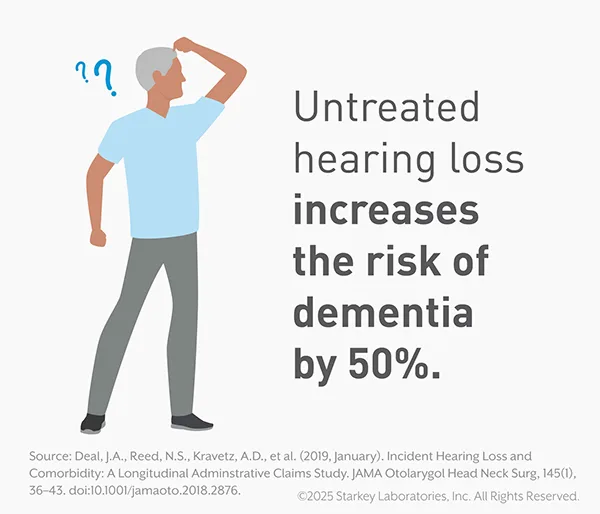
Research has also shown that untreated hearing loss is associated with a higher risk of cognitive decline and may be linked to conditions such as dementia and Alzheimer’s disease. Early identification and treatment of hearing loss can play an important role in supporting long-term brain health and quality of life.

Dementia

Recent research has identified hearing loss as one of the most significant treatable risk factors for dementia. Some studies also suggest that addressing hearing loss could potentially help reduce the risk of developing dementia in a portion of cases through early intervention and proper hearing care.

Mental fatigue

When hearing becomes difficult, the brain must work harder to interpret speech and fill in missing sounds. This added effort can lead to mental fatigue, increased stress, and reduced cognitive efficiency as mental resources are redirected toward listening rather than other cognitive tasks.

Brain tissue atrophy

Although some degree of brain shrinkage is a natural part of aging, untreated hearing loss may contribute to a faster rate of brain tissue changes. Reduced auditory stimulation can impact how the brain processes sound over time, potentially accelerating cognitive decline in some individuals.

Act Today: Treat Hearing Loss Before It’s Too Late

Taking care of your hearing is about more than improving sound—it’s about improving your overall quality of life. When left untreated, hearing loss can lead to frustration, mental fatigue, and a sense of disconnection from the people and activities that matter most.

At Magnolia Hearing Aid Center, LLC, our dedicated hearing care professionals are here to help you take the next step toward better hearing. With personalized evaluations and modern hearing solutions, we’re committed to helping you reconnect, communicate with confidence, and enjoy life more fully.

Don’t wait to take action—start your journey toward better hearing and better living today.

If you’re ready to take your hearing health seriously, schedule an appointment today.

  1. John Hopkins Bloomberg School of Public Health. Hearing Loss and the Dementia Connection. https://publichealth.jhu.edu/2021/hearing-loss-and-the-dementia-connection?_gl=1*rtkyns*_gcl_au*MzY4MTQwMDYxLjE3MTI2ODk2NzI.
  2. Prof Gill Livingston, MD; Jonathan Huntley, PhD; Andrew Sommerlad, PhD; Prof David Ames, MD; Prof Clive Ballard, MD; Prof Sube Banerjee, MD; et al. Dementia Prevention, Intervention, and Care: 2020 Report of the Lancet Commission. helancet.com. https://www.thelancet.com/article/S0140-6736(20)30367-6/fulltext?_gl=1*pnqor8*_gcl_au*MzY4MTQwMDYxLjE3MTI2ODk2NzI.#:~:text=Hearing%20loss%20had%20the%20highest%20PAF%20for%20dementia  https://www.thelancet.com/article/S0140-6736(20)30367-6/fulltext?_gl=1*pnqor8*_gcl_au*MzY4MTQwMDYxLjE3MTI2ODk2NzI.#:~:text=45%E2%80%9365%20years)-,Hearing%20loss,-1%C2%B79%20(1
  3. Livingston G, Sommerlad A, Orgeta V, et al. Dementia Prevention, Intervention, and Care. Lancet North Am Ed. 2017; 390(10113):2673‐2734. https://www.thelancet.com/journals/lancet/article/PIIS0140-6736(17)31363-6/abstract
  4. Nicole M. Armstrong, PhD; Yang An, MS; Jimit Doshi, MS; et al. Association of Midlife Hearing Impairment with Late-life Temporal Lobe Volume Loss. Jamanetwork.com.  https://jamanetwork.com/journals/jamaotolaryngology/article-abstract/2737210?_gl=1*1ilq6s4*_gcl_au*MzY4MTQwMDYxLjE3MTI2ODk2NzI.